Physics Education Research Group
During 2008-2009, PERG (a.k.a. UMPERG) transitioned from UMass to the University of North Carolina at Greensboro, where it joined the UNCG Department of Physics & Astronomy.
PERG is a team of physicists studying knowledge, cognition, learning, and teaching about physics and other sciences. We investigate fundamental questions in the cognitive science of physics learning and expertise; develop pedagogic techniques and curricula; and promote effective instruction within our university and around the world.
PERG was founded by Prof. William Gerace, a theoretical nuclear physicist, who began research into physics education in 1976. He was joined in turn by Jose Mestre, Robert Dufresne, and William Leonard, all of whom completed doctoral dissertations in theoretical nuclear physics before joining the educational research effort. Ian Beatty joined later, completing a Physics Ph.D. with a dissertation in physics education research. Over the years, UMPERG has employed and worked with many undergraduate and graduate students.
UMPERG was originally a research group within the UMass Department of Physics as well as a founding element of SRRI; in later years, it was solely affiliated with SRRI.
The information below may become increasingly obsolete as time passes. Caveat emptor.
Latest PERG News
Current PERG members:
PERG publicatons (reprints, preprints, technical reports, etc.):
See PERG's share of the SRRI publications list.
Current PERG projects:
This list is not complete.
→ There don't seem to be any projects to list here!
Past PERG projects:
This list is definitely not complete!
Teacher Learning of Technology-Enhanced Formative Assessment
TLT was a five-year research project studying how secondary science and mathematics teachers learn to use an electronic "classroom response system" to implement a specific pedagogical approach called Technology-Enhanced Formative Assessment (TEFA).
Online support for students doing electronic homework
At a large state university such as UMass, resources are necessarily limited, and students in a course with 200 or more classmates often think they cannot possibly get the assistance they need to answ
Developing and researching the impact of an alternative format for multiple-choice assessment
Standard multiple-choice assessments, for which there are 4 incorrect and exactly one correct choice, are efficient to implement but imprecise and difficult to interpret.
Researching the Role of Qualitative Analysis
RRA was a research project on the combined impact of qualitative analysis and reasoning activities and formative assessment on the attitudes, conceptual understanding, skills, and problem-solving prof
Assessing-to-Learn: Continuous Formative Assessment for Physics Instruction
There has been considerable interest in assessment, especially in view of the goals set forth in reform documents, such as the NRC's National Science Education Standards.
Computer-based assessment tools for probing physics students' conceptual knowledge structures
Traditional problem-based exams are not reliable tools for diagnosing students' knowledge and guiding pedagogical intervention; new tools grounded in cognitive science and educational research are nee
Developing and field testing a research-based curriculum for high school physics
Exploring technology for next-generation classroom response systems
Effective pedagogy --- identifying students' initial understanding and misconceptions, engaging their minds in the activity of learning, continually monitoring their individual progress, and adjusting
Published PERG "products":
A constructivist, active-learning curriculum for high school physics
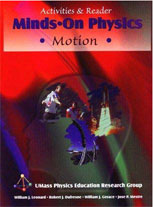
MOP is a one-year curriculum for high school physics. It is the result of a materials development project supported by the National Science Foundation, and its design was guided by educational research findings. The curriculum integrates topics traditionally taught at different times of the year, and students are expected to develop conceptual understanding of physics while improving problem-solving proficiency.
A simple but rich mechanical system for teaching about the physics of jumping
(This is a companion website to the article
Springbok: The physics of jumping, published in
The Physics Teacher.)
Springbok is our name for a simple mechanical system for teaching about the physics of jumping. A springbok consists of a large mass and a small mass connected by a spring; when compressed and then released, it jumps up into the air.

