
SERG
Statistics Education Research Group
Group Page:
SERG
Contact(s):
Konold, Cliff SERG is a group of researchers with backgrounds in psychology, education, and computer science who have been collaborating since the late 1970's. The group's mission is to better understand how people reason about probability, statistics, and data analysis, and to use this understanding to improve the teaching of these topics at both the university and K-12 levels. Research initially focused on how adults reason about statistics and probability before receiving any formal instruction. More recent work has focused on younger students learning about data and chance and how their understanding develops over instruction in technology-rich environments.
Latest SERG News
Current SERG members:
| Konold, Cliff | Director of SRRI & Research Associate Professor |
| Kreetong, Kosoom (Jang) | Ed.D student (Mathematics, Science and Learning Technologies), Webmaster |
SERG publications (reprints, preprints, technical reports, etc.):
See the SRRI publications list.
Current SERG projects:
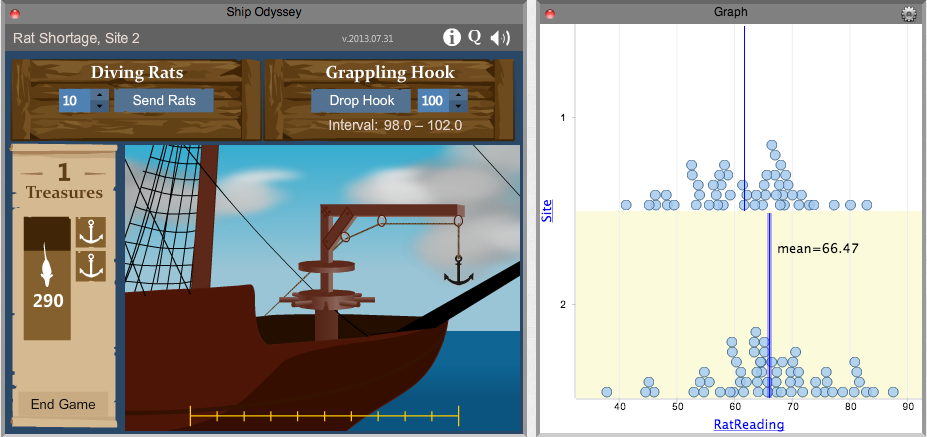 Students playing computer games generate large quantities of rich, interesting, highly variable data that mostly evaporates into the ether when the game ends.
Past SERG projects:
Published SERG "products":
 DataScope® was a Macintosh Classic data-analysis program from the 1990s with accompanying data sets and instructional activities for grades 9-13.
 Grow Average© was a Macintosh (Classic) program from the 1990s for demonstrating the Law of Large Numbers and the Central Limits Theorem.
- Printer-friendly version
- Login to post comments
