The Conceptual Learning in Science Group has been engaged in science education research activities within SRRI for the past 18 years, with the help of Professors Melvin Steinberg and Neil Stillings, and many doctoral students and postdocs. Our work has focused on analogies, misconceptions, useful intuitions, creativity and imagery use in experts, model based learning, co-construction strategies, computer simulations, gesture analysis, and other topics. The group has been funded virtually continuously during this period by the US National Science Foundation.
Latest CLSG News
- 01/17/2008 - 8:07pm
- 11/27/2007 - 3:50pm
Current CLSG members:
| Clement, John J. | Professor of Education |
| Leibovitch, Abigail | Ph.D. Student, School Psychology |
| Stephens, A. Lynn | Ed.D. Student, Teacher Education & Curriculum Studies |
| Williams, E. Grant | Ed.D. Student, Teacher Education & Curriculum Studies |
| Young, Raymond | Ed.D. Student, Teacher Education & Curriculum Studies |
| Forrelli, Kristen | Undergraduate Assistant (Journalism Major) |
| Rawlings, Jennifer | Undergraduate Assistant (Legal Studies & Journalism Major) |
CLSG publicatons (reprints, preprints, technical reports, etc.):
See the SRRI publications list.
Current CLSG projects:
Visual Modeling Strategies in Science Teaching
Deepening Conceptual Understanding in Middle School Life Science
Model Construction Processes in Experts
Past CLSG projects:
→ There don’t seem to be any projects to list here!
Published CLSG “products”:
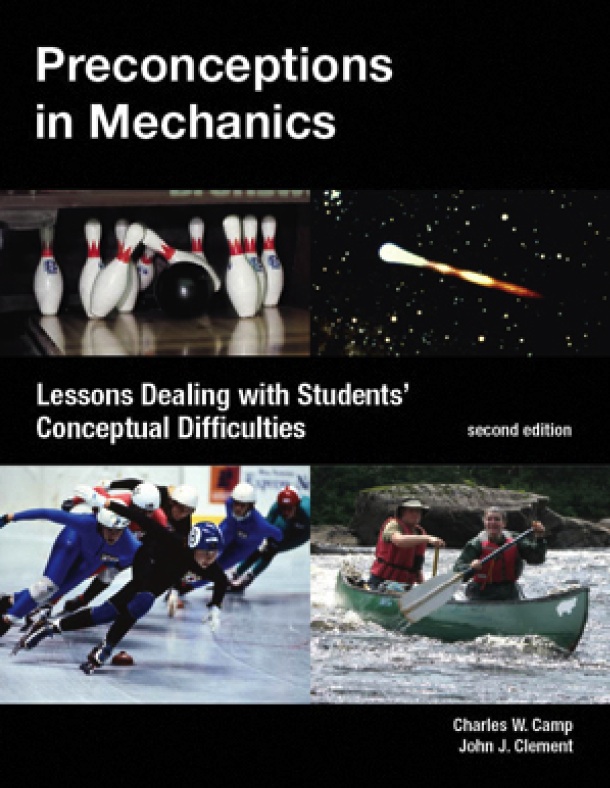
Preconceptions in Mechanics
by Charles Camp and John Clement. Contributing authors: David Brown, Kimberly Gonzalez, John Kudukey, James
Minstrell, Klaus Schultz, Melvin Steinberg, Valerie Veneman, and Aletta Zietsman. ©1994. Dubuque, Iowa: Kendall/Hunt.
The nine units in this high school physics curriculum focus on areas where students have exhibited qualitative preconceptions — ideas that they bring to class with them prior to instruction in physics. Research has shown that certain preconceptions conflict with the physicist’s point of view. It has also shown that some of these conflicting preconceptions are quite persistent and seem to resist change in the face of normal instructional techniques. The motivating idea for this book is to provide a set of lessons that are aimed specifically at these particularly troublesome areas and that use special techniques for dealing with them. Ideas in the lessons can be used to supplement any course that includes mechanics.
This page is maintained by